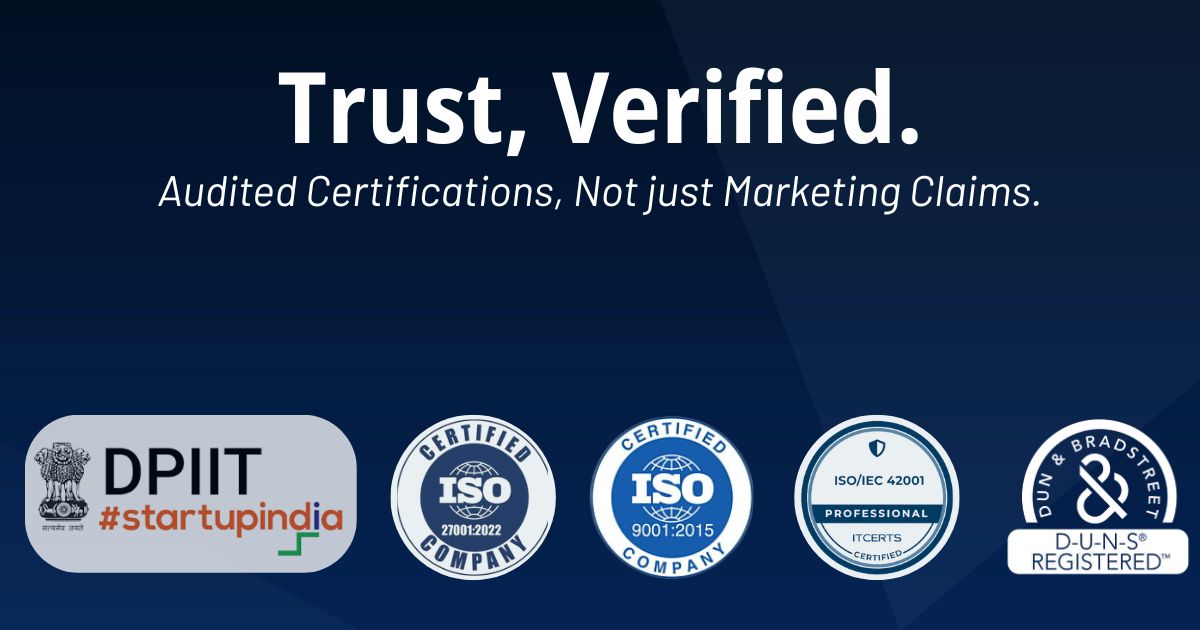
Most software companies in India put a row of certification badges in their website footer and leave it at that. Nobody explains what the badges actually mean, what they took to get, or why a client should care. So here's the plain-language version — written by someone who's actually gone through the process, not just displayed the logo.
🎯 Key Takeaways
- ISO 9001:2015 certifies your quality management process, not your product quality directly
- ISO 27001:2022 certifies how you handle information security — access control, data handling, incident response
- DPIIT recognition confirms a company is a registered, government-tracked startup entity, not a claim
- None of these certifications are self-issued — they require external audits, which is exactly why they're a useful trust signal for a buyer who can't verify a small vendor any other way
ISO 9001:2015 — Quality Management
ISO 9001 doesn't certify that your code is good. It certifies that you have a documented, repeatable process for how work gets planned, executed, reviewed, and delivered. That distinction matters. A company without this certification can still write excellent code — but you have no external verification that their process is consistent across projects and team members, rather than dependent on one senior developer's personal discipline.
In practice, what ISO 9001 requires a company to have in place:
- Documented processes for requirement gathering, development, and QA
- Defined roles and responsibilities across the delivery pipeline
- A system for tracking and resolving client feedback and non-conformances
- Regular internal audits and management review of the whole process
An auditor doesn't just take your word for this. ISO 9001 certification involves an external body reviewing your actual documentation and interviewing your team — it's not a form you fill out and pay for.
ISO 27001:2022 — Information Security Management
This is the one that matters most if your product involves user data, payments, health records, or anything else you'd be uncomfortable seeing leaked. ISO 27001 certifies an organization's Information Security Management System (ISMS) — essentially, how seriously and systematically a company protects data it has access to.
What it actually covers:
- Access control — who inside the company can see what, and why
- Data handling and storage policies, including how client code and credentials are managed
- Incident response procedures — what happens if something goes wrong, and how fast it's disclosed
- Risk assessment processes that get reviewed and updated, not written once and forgotten
If you're building anything in fintech, healthcare, or EdTech — anywhere handling student, patient, or financial data — this certification is the difference between "they said they take security seriously" and "an external auditor confirmed they have a system for it."
Clients rarely ask to see the ISO audit report itself, but they should. It's the one document that tells you whether a security claim is real or just marketing copy.
DPIIT Recognition — What It's Actually Confirming
DPIIT stands for the Department for Promotion of Industry and Internal Trade, the Government of India body that administers the official Startup India recognition program. A DPIIT-recognised company has gone through a formal registration process confirming it's a genuine, incorporated startup entity — not a loose collective operating informally, and not a shell registered purely for tax benefits without real operations behind it.
For a client, this mostly matters as a baseline legitimacy check: the company exists as a real, traceable legal entity, has gone through government-level registration scrutiny, and isn't a two-person operation working under a name with no formal structure behind it.
Why This Matters More for Smaller and Regional Companies
If you're evaluating a large, well-known agency with decades of public track record, certifications matter less — their reputation already does the work. But if you're evaluating a smaller studio, especially one based outside the major metros, you often can't verify their track record the same way. You can't call a dozen of their past clients. You probably haven't heard of them from anyone in your network.
That's exactly where these certifications earn their keep. They're independently audited, they're a matter of public record, and they let you verify a claim in thirty seconds instead of taking it on faith.
Before signing with any dev partner, ask for their certificate numbers directly — ISO certificates are registered and verifiable, and a company with nothing to hide will hand them over without hesitation.
Net Stratix holds ISO 9001:2015 and ISO 27001:2022 certification, is DPIIT-recognised, and is D&B registered (DUNS: 642907449). If you'd like to verify any of it before we talk about your project, reach out — we'd rather you check than take our word for it.